

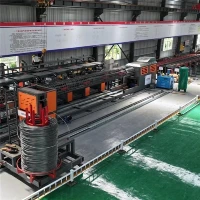

As a supplier of pile cage welding machines, I've had the privilege of witnessing firsthand the remarkable advancements in welding technology. One of the most critical aspects of any welding process, including those used in pile cage welding machines, is the control of welding current and voltage. In this blog post, I'll delve into the intricacies of how our pile cage welding machines achieve precise control over these parameters, ensuring high - quality welds every time.
Understanding the Basics of Welding Current and Voltage
Before we explore the control mechanisms, it's essential to understand the roles of welding current and voltage. Welding current is the flow of electric charge through the welding circuit. It directly affects the heat input into the weld joint. A higher current results in more heat, which can penetrate deeper into the materials being welded, but it also increases the risk of over - heating and distortion. On the other hand, a lower current may not provide enough heat to create a strong weld.
Welding voltage, on the other hand, is the electrical potential difference between the electrode and the workpiece. It influences the arc length and the stability of the welding arc. A proper voltage setting is crucial for maintaining a consistent arc, which is necessary for a uniform and high - quality weld.
Control Mechanisms in Pile Cage Welding Machines
Electronic Control Systems
Our pile cage welding machines are equipped with state - of - the - art electronic control systems. These systems use microcontrollers and advanced algorithms to monitor and adjust the welding current and voltage in real - time. The microcontroller continuously gathers data from sensors placed throughout the welding circuit. These sensors measure parameters such as the actual current and voltage values, as well as the temperature and resistance of the weld area.
Based on the pre - set welding parameters, the microcontroller can make instant adjustments to the current and voltage. For example, if the current starts to deviate from the set value due to changes in the workpiece thickness or the electrode condition, the control system will automatically increase or decrease the power supply to maintain the desired current level. This real - time adjustment ensures that the weld quality remains consistent throughout the welding process.
Feedback Loops
Feedback loops are an integral part of the control system in our pile cage welding machines. A feedback loop works by comparing the actual output (the measured current and voltage) with the desired setpoint. If there is a difference between the two, the control system will take corrective action.
For instance, if the measured welding current is lower than the setpoint, the feedback loop will signal the power supply unit to increase the output current. Conversely, if the current is too high, the system will reduce the power output. This continuous monitoring and adjustment process ensures that the welding parameters remain within the optimal range, resulting in high - quality and reliable welds.


Remote Monitoring and Control
In addition to the on - board control systems, our pile cage welding machines support remote monitoring and control. Using wireless communication technologies, operators can access the welding machine's control panel from a remote location. This feature allows for real - time monitoring of the welding current and voltage, as well as the ability to make adjustments without having to be physically present at the machine.
Remote monitoring also enables predictive maintenance. By analyzing the historical data of the welding parameters, we can predict when components of the welding machine may need servicing or replacement. This proactive approach helps to minimize downtime and ensure the long - term reliability of the machine.
Advantages of Precise Current and Voltage Control
Improved Weld Quality
The most significant advantage of precise control over welding current and voltage is the improvement in weld quality. When the current and voltage are accurately controlled, the welds are more consistent in terms of penetration, bead shape, and strength. This means that the pile cages produced by our welding machines have a higher structural integrity, which is crucial for their performance in construction projects.
Reduced Material Waste
Precise control also helps to reduce material waste. By maintaining the optimal welding parameters, we can minimize the amount of excess filler material used in the welding process. Additionally, the risk of weld defects such as porosity and cracks is significantly reduced, which means fewer rejected parts and less scrap material.
Increased Productivity
With accurate control of current and voltage, the welding process can be optimized for speed without sacrificing quality. Our pile cage welding machines can operate at higher welding speeds, reducing the overall production time. This increased productivity allows our customers to meet their project deadlines more efficiently and take on more orders.
Our Product Range
As a leading supplier of pile cage welding machines, we offer a wide range of products to meet the diverse needs of our customers. Our Round Rebar Cage Roll Welding Machine is designed for the efficient production of round rebar cages. It is equipped with advanced control systems to ensure precise control over the welding current and voltage, resulting in high - quality and uniform welds.
Our Rebar Cage Welder is a computer - numerical - controlled (CNC) machine that offers even greater precision and flexibility. It can be programmed to create complex rebar cage designs with high accuracy, and the control system ensures that the welding parameters are maintained at the optimal levels throughout the process.
For larger - scale production, our Steel Bar Cage Welding Machine is the ideal choice. It has a high - capacity welding unit and advanced control features that allow for fast and efficient production of steel bar cages.
Conclusion
In conclusion, the control of welding current and voltage is a crucial aspect of the pile cage welding process. Our pile cage welding machines use advanced electronic control systems, feedback loops, and remote monitoring capabilities to achieve precise control over these parameters. This results in improved weld quality, reduced material waste, and increased productivity.
If you are in the market for a high - quality pile cage welding machine, we invite you to contact us for more information. Our team of experts is ready to answer your questions and help you find the perfect machine for your specific needs. Whether you are a small - scale contractor or a large construction company, we have the right solution for you. Let's start a conversation about how our pile cage welding machines can enhance your production process and take your business to the next level.
References
- Welding Handbook, American Welding Society
- Principles of Welding Technology, John Wiley & Sons