


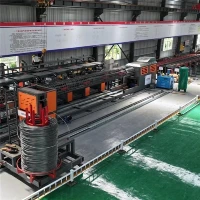
As a supplier of electric rebar cut lines, I've seen firsthand the challenges that come with dealing with burrs. Burrs are those annoying little bits of metal that stick out after the rebar is cut. They can be a real pain, not just for the look of the rebar but also for safety and further processing. In this blog, I'll share some effective ways to remove the burrs produced by an electric rebar cut line.
Understanding the Problem
First off, let's talk about why burrs form in the first place. When an electric rebar cut line slices through the rebar, the force applied can cause the metal to deform at the edges. This deformation results in burrs. The type of rebar, the cutting speed, and the sharpness of the cutting blade all play a role in how many and how big the burrs are.
For instance, if the cutting blade is dull, it will require more force to cut through the rebar. This extra force can lead to more significant burrs. Similarly, cutting at a high speed might not give the blade enough time to make a clean cut, also causing burrs.
Manual Burr Removal Methods
One of the simplest ways to remove burrs is by using hand tools. Files are a classic choice. You can use a flat file to smooth out the edges of the cut rebar. Just run the file back and forth along the edge, applying a bit of pressure. It's a bit labor - intensive, but it can be very effective for small - scale operations or when you need to do some touch - up work.


Another option is a deburring tool. These are specifically designed to remove burrs. They come in different shapes and sizes, and some are even adjustable to fit different rebar diameters. You just place the tool on the edge of the rebar and rotate it to remove the burrs.
Mechanical Burr Removal
For larger - scale operations, mechanical deburring machines are a great solution. There are several types available.
One type is the tumbling machine. You put the cut rebar into a drum along with abrasive media. As the drum rotates, the rebar tumbles around, and the abrasive media rubs against the edges, removing the burrs. This method is efficient for large quantities of rebar, but it might not be suitable for very long or large - diameter rebar.
Another mechanical option is a belt sander. You can set up the rebar so that the cut edge passes over the moving sanding belt. The sandpaper on the belt grinds away the burrs. Belt sanders can be adjusted to different speeds and pressures, allowing for precise deburring.
Chemical Deburring
Chemical deburring is another approach. You can use a chemical solution that dissolves the burrs. This method is often used for more complex shapes or when you need to deburr hard - to - reach areas. However, it's important to use the right chemicals and follow safety procedures. Some chemicals can be hazardous, so proper ventilation and protective gear are a must.
Preventing Burrs in the First Place
Of course, the best way to deal with burrs is to prevent them from forming. As a supplier of Electric Rebar Cutting Line, I can tell you that maintaining the cutting equipment is crucial. Keep the cutting blades sharp. Dull blades are a major cause of burrs. You should also make sure the cutting speed is appropriate for the type and diameter of the rebar.
Checking the alignment of the rebar in the cut line is also important. If the rebar is not properly aligned, it can cause uneven cutting and more burrs.
Impact of Burrs on Further Processing
Burrs can have a significant impact on further processing of the rebar. In construction, for example, if the rebar has burrs, it can be difficult to tie the rebar together. The burrs can also damage the formwork or other construction materials.
In manufacturing processes, burrs can interfere with the fitting of parts. They can cause misalignments and make it difficult to assemble components. So, removing burrs is not just about aesthetics; it's also about functionality.
Cost - Benefit Analysis
When considering the different methods of burr removal, it's important to do a cost - benefit analysis. Manual methods are cheap in terms of equipment cost, but they are time - consuming and labor - intensive. Mechanical methods can be more expensive to set up, but they are much faster and more efficient for large - scale production. Chemical deburring can be costly in terms of the chemicals and safety equipment, but it can be very effective for certain applications.
Our Electric Rebar Cut Lines and Burr Management
At our company, we offer Electric Reinforcement Cut Line and Electric Steel Bar Shear Line that are designed to minimize burr formation. Our cutting blades are made of high - quality materials and are engineered for a clean cut. We also provide support and advice on how to further reduce burrs and manage them effectively.
If you're in the market for an electric rebar cut line or need help with burr removal, don't hesitate to get in touch. We're here to help you find the best solution for your needs. Whether you have a small - scale project or a large - scale production line, we can offer the right equipment and guidance.
Conclusion
Dealing with burrs produced by an electric rebar cut line is a common challenge, but there are many effective ways to remove them. From manual methods to mechanical and chemical solutions, each has its own advantages and disadvantages. By understanding the causes of burrs and taking steps to prevent them, you can save time and money in the long run. And if you're looking for a reliable electric rebar cut line supplier, we're here to assist you. So, if you're interested in our products or need more information, feel free to reach out for a chat and let's discuss your requirements.
References
- Metalworking Machinery Handbook
- Construction Materials and Processes Manual