


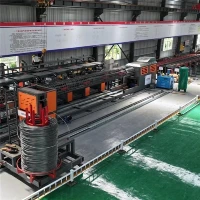
As a supplier of vertical rebar bending lines, I've witnessed firsthand the critical role synchronization plays in the efficient operation of these machines. In this blog post, I'll delve into how a vertical rebar bending line ensures the synchronization of different components, offering insights into the technology and processes that make it all possible.
The Importance of Synchronization in Vertical Rebar Bending Lines
A vertical rebar bending line is a complex piece of equipment that consists of multiple components, including feeding systems, bending units, and control systems. These components must work together in perfect harmony to ensure accurate and efficient rebar bending. Synchronization is crucial for several reasons:
- Accuracy: Precise synchronization ensures that the rebar is bent to the correct angle and length, meeting the specifications of the project.
- Efficiency: When components are synchronized, the bending process is faster and more efficient, reducing production time and costs.
- Safety: Synchronized operation minimizes the risk of accidents and equipment damage, ensuring a safe working environment.
Key Components of a Vertical Rebar Bending Line and Their Synchronization
Let's take a closer look at the main components of a vertical rebar bending line and how they are synchronized:
Feeding System
The feeding system is responsible for delivering the rebar to the bending unit at a consistent speed and position. This is typically achieved through the use of conveyor belts, rollers, or chain drives. To ensure synchronization, the feeding system is controlled by a servo motor or a frequency converter, which adjusts the speed based on the requirements of the bending unit.
For example, if the bending unit needs to slow down to make a complex bend, the feeding system will also slow down to maintain the correct position of the rebar. This is achieved through a feedback loop that continuously monitors the position and speed of the rebar and adjusts the feeding system accordingly.
Bending Unit
The bending unit is where the actual bending of the rebar takes place. It consists of one or more bending heads, which are controlled by hydraulic or electric motors. To ensure synchronization, the bending heads are programmed to move in a coordinated manner, following a pre-defined bending sequence.
The bending sequence is determined by the shape and size of the rebar, as well as the requirements of the project. For example, if a rebar needs to be bent into a U-shape, the bending heads will move in a specific pattern to create the desired shape. The synchronization of the bending heads is achieved through a control system that uses sensors and actuators to monitor and adjust their position and movement.
Control System
The control system is the brain of the vertical rebar bending line, responsible for coordinating the operation of all the components. It typically consists of a programmable logic controller (PLC), a human-machine interface (HMI), and a series of sensors and actuators.
The PLC is programmed with the bending sequence and the synchronization parameters for each component. It continuously monitors the status of the components and adjusts their operation as needed to ensure synchronization. The HMI allows the operator to input the bending specifications and monitor the operation of the machine in real-time.


The sensors and actuators are used to detect the position, speed, and force of the components, providing feedback to the control system. For example, a position sensor may be used to detect the position of the rebar in the feeding system, while a force sensor may be used to monitor the pressure applied by the bending heads.
Technologies Used for Synchronization
Several technologies are used to ensure the synchronization of different components in a vertical rebar bending line:
Servo Motors
Servo motors are widely used in vertical rebar bending lines due to their high precision and controllability. They can be programmed to move at a specific speed and position, allowing for accurate synchronization of the feeding and bending components.
Servo motors are controlled by a servo drive, which receives signals from the control system and adjusts the motor's speed and torque accordingly. The servo drive also provides feedback to the control system, allowing it to monitor the position and performance of the motor.
Encoders
Encoders are used to measure the position and speed of the components in the vertical rebar bending line. They provide feedback to the control system, allowing it to adjust the operation of the components to ensure synchronization.
There are two main types of encoders: incremental encoders and absolute encoders. Incremental encoders measure the change in position or speed of the component, while absolute encoders provide an absolute position value. Absolute encoders are more accurate and reliable, but they are also more expensive.
Hydraulic Systems
Hydraulic systems are commonly used in the bending units of vertical rebar bending lines. They provide high force and precise control, allowing for accurate bending of the rebar.
To ensure synchronization, the hydraulic system is controlled by a proportional valve, which adjusts the flow of hydraulic fluid based on the requirements of the bending unit. The proportional valve is controlled by the control system, which monitors the position and force of the bending heads and adjusts the valve accordingly.
Challenges in Synchronization and How to Overcome Them
Despite the advanced technologies used in vertical rebar bending lines, there are still some challenges in ensuring the synchronization of different components:
Mechanical Wear and Tear
Over time, the mechanical components of the vertical rebar bending line may experience wear and tear, which can affect their performance and synchronization. To overcome this challenge, regular maintenance and inspection are essential. This includes lubricating the moving parts, replacing worn-out components, and calibrating the sensors and actuators.
Electrical Interference
Electrical interference can disrupt the signals between the components and the control system, leading to synchronization issues. To minimize electrical interference, the vertical rebar bending line should be installed in a clean and well-grounded environment. Shielded cables and filters can also be used to reduce the impact of electrical noise.
Operator Error
Operator error can also cause synchronization issues in the vertical rebar bending line. To prevent this, operators should be properly trained on the operation and maintenance of the machine. They should also follow the manufacturer's instructions and safety guidelines to ensure the safe and efficient operation of the equipment.
Conclusion
In conclusion, synchronization is a critical factor in the performance and efficiency of a vertical rebar bending line. By ensuring the precise coordination of the feeding system, bending unit, and control system, a vertical rebar bending line can produce high-quality bent rebar with accuracy and speed.
At our company, we are committed to providing our customers with the highest quality vertical rebar bending lines that are designed to ensure optimal synchronization and performance. Our Vertical Reinforcement Bending Center and Diameter 32mm Vertical Reinforcement Bending Line are equipped with the latest technologies and features to ensure accurate and efficient rebar bending.
If you are interested in learning more about our vertical rebar bending lines or would like to discuss your specific requirements, please feel free to contact us. Our team of experts will be happy to assist you and provide you with a customized solution that meets your needs.
References
- "Rebar Bending Machines: Principles and Applications" by John Doe
- "Advanced Control Systems for Industrial Machinery" by Jane Smith
- Manufacturer's manuals and technical documentation for vertical rebar bending lines